• Dameon Priestly
  • Collections
  • Shop
  • Interviews
  • Talks
  • Articles
  • Contact
Menu

Dameon Priestly

Studio 3, Halpern Gallery
15a High Street, Rochester, Medway ME1 1PY
07989711965
Artist

Artist

Dameon Priestly

  • Dameon Priestly
  • Collections
  • Shop
  • Interviews
  • Talks
  • Articles
  • Contact

NO! 1968

1968 was a year of refusal.


Across different countries, and for very different reasons, people challenged the political and social orders they had inherited. In Northern Ireland, the civil rights movement confronted discrimination in housing, employment and voting, with One Man, One Vote among its defining demands. In Paris, student protest grew into a national crisis as millions of workers joined strikes. In the United States, opposition to the Vietnam War intensified as the Tet Offensive challenged official accounts of a war being won and American soldiers killed hundreds of Vietnamese civilians at My Lai. Martin Luther King Jr. was assassinated in April, followed by unrest across American cities; Robert Kennedy was murdered two months later. In August, as police confronted anti-war demonstrators outside the Democratic National Convention in Chicago, the crowd chanted The Whole World Is Watching.


These were not one movement and did not share one cause. But within the space of a single year, questions of civil rights, war, democracy, inequality and authority repeatedly collided with established power.


For Dameon Priestly, that history also has a personal connection. His grandfather took part in the Northern Ireland civil rights protests of 1968.


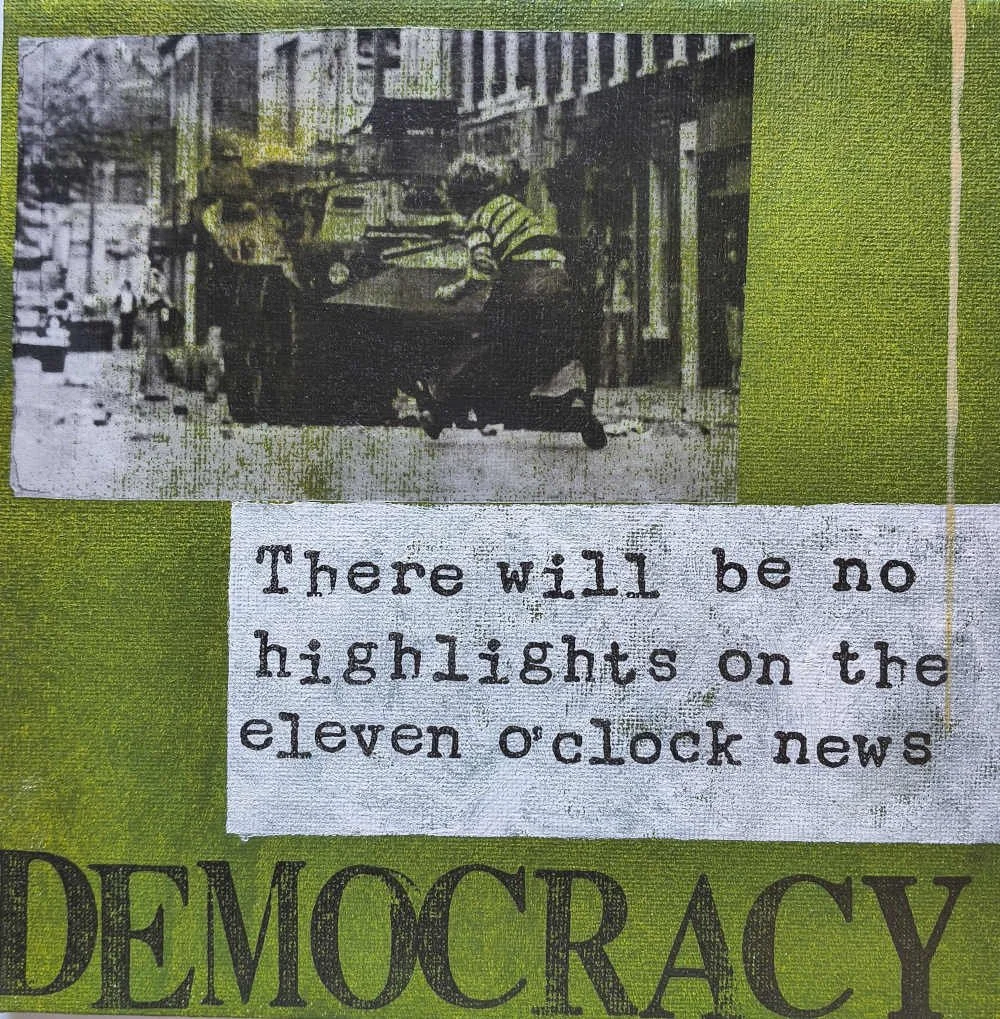
NO! 1968 does not reconstruct the year or impose a single narrative upon it. Priestly takes its political and visual language as material. Through collage and paint, image, text, colour and surface are constructed together: imagery is cropped, repeated, obscured and absorbed; words are enlarged, interrupted, rotated or pushed beyond the edge of the composition.


A restricted palette of acidic greens, ochres and yellows, faded blues, greys and black moves across the exhibition, punctuated by eruptions of stronger colour. Surfaces are layered, scraped and disrupted. At the smallest scale, immense events are compressed into ten-centimetre squares that draw the viewer close; in larger works, repetition and scale create a different kind of insistence.


ONE MAN ONE VOTE.
LIBERTÉ.
DEMOCRACY.
SHOOT TO KILL.
THE WHOLE WORLD IS WATCHING.


Political aspiration, protest, threat and violence occupy the same visual space. Words do not explain the imagery, nor does imagery simply illustrate the words. Meaning is created — and unsettled — through their relationship with colour, surface and composition.


In one work, words from The Star-Spangled Banner move across the repeated image of a summary execution in Saigon, bringing the language of national identity into direct contact with the violence of war. Elsewhere, fragments of the Rolling Stones' Sympathy for the Devil, written and recorded in 1968, enter works concerned with assassination and My Lai. Popular culture is not a soundtrack to history, but part of the material through which that history is questioned.


Who is speaking? Who is being watched? Who is doing the watching? What happens when the language through which a society describes itself comes into conflict with what is being done in its name?


Even the title refuses a single meaning.
NO! is the language of resistance: a refusal of war, discrimination, exclusion and established authority. But refusal did not belong only to those demanding change. Governments and institutions resisted those demands. Power said no too.


More than half a century later, Priestly offers no resolution. The works retain their fractures and contradictions. Words that appear certain become less so in relation to what surrounds them. The distance between political ideals and lived reality remains visible, while the boundary between history and the present becomes less comfortable the longer we look.


The events belong to 1968. The works do not allow them to remain there.
NO! 1968

1968 was a year of refusal.


Across different countries, and for very different reasons, people challenged the political and social orders they had inherited. In Northern Ireland, the civil rights movement confronted discrimination in housing, employment and voting, with One Man, One Vote among its defining demands. In Paris, student protest grew into a national crisis as millions of workers joined strikes. In the United States, opposition to the Vietnam War intensified as the Tet Offensive challenged official accounts of a war being won and American soldiers killed hundreds of Vietnamese civilians at My Lai. Martin Luther King Jr. was assassinated in April, followed by unrest across American cities; Robert Kennedy was murdered two months later. In August, as police confronted anti-war demonstrators outside the Democratic National Convention in Chicago, the crowd chanted The Whole World Is Watching.


These were not one movement and did not share one cause. But within the space of a single year, questions of civil rights, war, democracy, inequality and authority repeatedly collided with established power.


For Dameon Priestly, that history also has a personal connection. His grandfather took part in the Northern Ireland civil rights protests of 1968.


NO! 1968 does not reconstruct the year or impose a single narrative upon it. Priestly takes its political and visual language as material. Through collage and paint, image, text, colour and surface are constructed together: imagery is cropped, repeated, obscured and absorbed; words are enlarged, interrupted, rotated or pushed beyond the edge of the composition.


A restricted palette of acidic greens, ochres and yellows, faded blues, greys and black moves across the exhibition, punctuated by eruptions of stronger colour. Surfaces are layered, scraped and disrupted. At the smallest scale, immense events are compressed into ten-centimetre squares that draw the viewer close; in larger works, repetition and scale create a different kind of insistence.


ONE MAN ONE VOTE.
LIBERTÉ.
DEMOCRACY.
SHOOT TO KILL.
THE WHOLE WORLD IS WATCHING.


Political aspiration, protest, threat and violence occupy the same visual space. Words do not explain the imagery, nor does imagery simply illustrate the words. Meaning is created — and unsettled — through their relationship with colour, surface and composition.


In one work, words from The Star-Spangled Banner move across the repeated image of a summary execution in Saigon, bringing the language of national identity into direct contact with the violence of war. Elsewhere, fragments of the Rolling Stones' Sympathy for the Devil, written and recorded in 1968, enter works concerned with assassination and My Lai. Popular culture is not a soundtrack to history, but part of the material through which that history is questioned.


Who is speaking? Who is being watched? Who is doing the watching? What happens when the language through which a society describes itself comes into conflict with what is being done in its name?


Even the title refuses a single meaning.
NO! is the language of resistance: a refusal of war, discrimination, exclusion and established authority. But refusal did not belong only to those demanding change. Governments and institutions resisted those demands. Power said no too.


More than half a century later, Priestly offers no resolution. The works retain their fractures and contradictions. Words that appear certain become less so in relation to what surrounds them. The distance between political ideals and lived reality remains visible, while the boundary between history and the present becomes less comfortable the longer we look.


The events belong to 1968. The works do not allow them to remain there.

Summary Block
This block is invalid. Please check the block settings and try again.
Featured
Aenean eu leo Quam
Aenean eu leo Quam

Quisque iaculis facilisis lacinia. Mauris euismod pellentesque tellus sit amet mollis.

Read more →

View collections  →